How to Calculate a Percentage of a Number
How to Calculate a Percentage of a Number
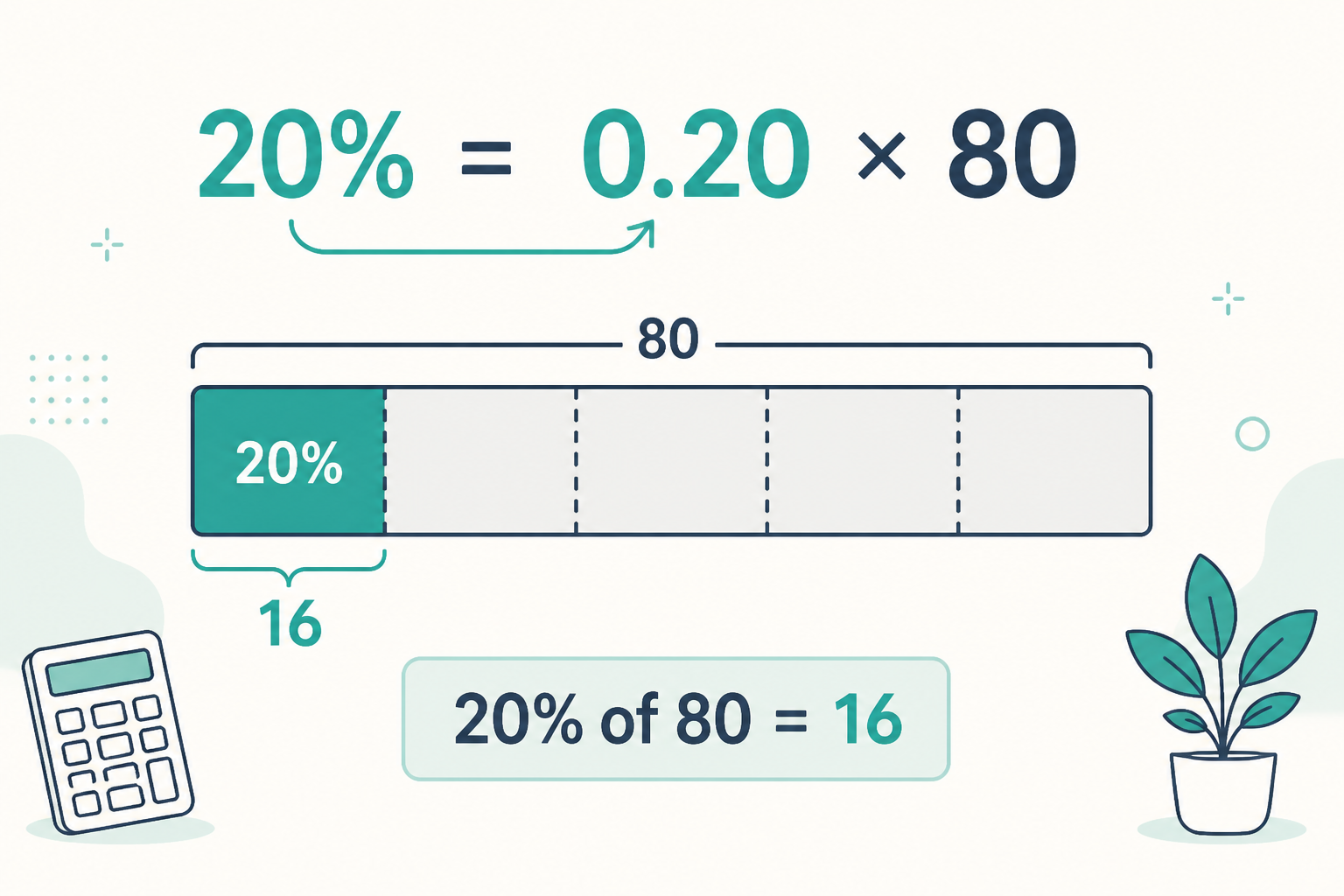
Calculate a percentage of a number by converting the percentage to a decimal, then multiplying that decimal by the number. Divide the percentage by 100 to get the decimal, and multiply. For 20% of 80, divide 20 by 100 to get 0.20, then multiply 0.20 by 80 to reach 16. A percentage is a part per hundred, so “percent” means “per 100”.
This one operation covers tips, discounts, tax, grades, and interest, because each asks for a part of a whole. The Percentage Calculator returns the answer and shows the working, and the method below explains each step so the result is clear by hand.
The Percentage Formula
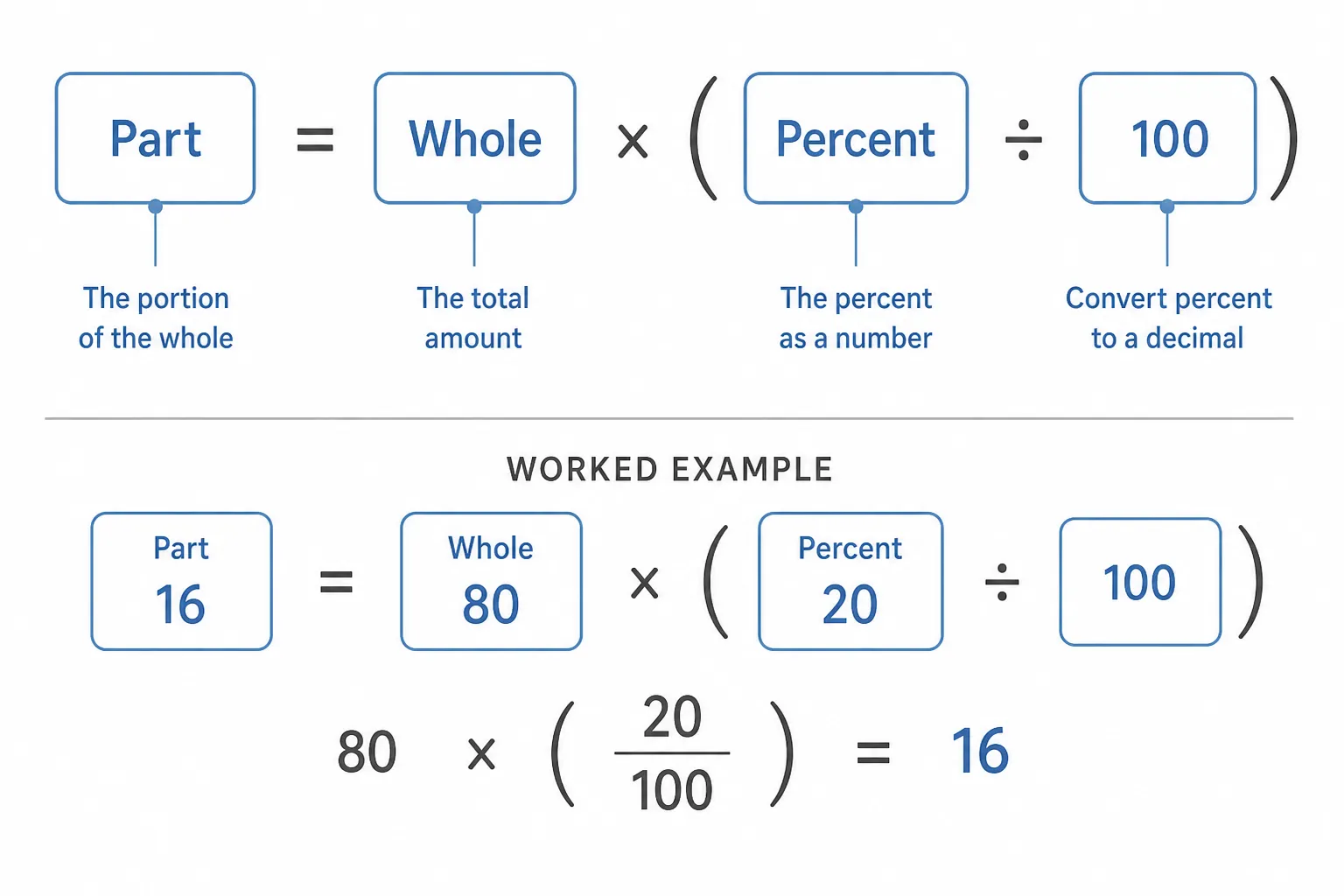
The formula for a percentage of a number is Part = Whole × (Percent ÷ 100). The whole is the number you start with, the percent is the rate, and the part is the answer. Dividing the percent by 100 turns it into a decimal, and multiplying scales the whole down to that share.
For 25% of 240, divide 25 by 100 to get 0.25, then multiply 240 by 0.25 to reach 60. The same formula runs in reverse for other questions: it finds the part when the whole and percent are known, which is the most common percentage task.
How to Calculate a Percentage Step by Step
Calculate a percentage of a number in 3 steps:
- Divide the percentage by 100 to convert it to a decimal.
- Multiply the decimal by the number you want the percentage of.
- Read the product as the part, in the same units as the original number.
For 40% of 150, divide 40 by 100 to get 0.40, then multiply 0.40 by 150 to reach 60. The percent-to-decimal step is where most errors start, so move the decimal point two places left: 40% becomes 0.40, 7% becomes 0.07, and 125% becomes 1.25.
Worked Examples
The table below calculates three percentages with the same formula. Each converts the percent to a decimal, then multiplies.
| Question | Decimal | Calculation | Answer |
|---|---|---|---|
| 20% of 80 | 0.20 | 0.20 × 80 | 16 |
| 15% of 200 | 0.15 | 0.15 × 200 | 30 |
| 7% of 350 | 0.07 | 0.07 × 350 | 24.5 |
Each answer keeps the units of the original number, so 7% of a 350-dollar bill is 24.50 dollars. A percentage above 100 gives an answer larger than the whole: 125% of 80 is 1.25 × 80 = 100.
How to Find a Percentage Without a Calculator
A percentage of a number can be found by hand by breaking it into easy parts. Find 10% by moving the decimal one place left, and find 1% by moving it two places left. Combine those pieces to reach any percentage.
For 35% of 60, 10% of 60 is 6, so 30% is 18. Then 5% is half of 10%, which is 3, and 18 plus 3 gives 21. This mental method suits tips and quick estimates, and it matches what the percentage calculator returns for the same input.
How to Calculate What Percentage One Number Is of Another
To find what percentage one number is of another, divide the part by the whole, then multiply by 100. For what percentage 16 is of 80, divide 16 by 80 to get 0.20, then multiply by 100 to reach 20%. This reverses the standard calculation, solving for the percent instead of the part.
This form answers questions such as a test score of 42 out of 50: divide 42 by 50 to get 0.84, then multiply by 100 for 84%. Keeping the part and the whole in the right positions is the key step, because dividing the whole by the part gives the wrong result.
How to Calculate a Percentage Increase or Decrease
A percentage change measures how much a value rose or fell relative to its starting point. Find the difference between the new and original values, divide by the original value, then multiply by 100. A rise from 80 to 100 is a difference of 20, divided by 80 is 0.25, which is a 25% increase.
A decrease uses the same steps. A fall from 100 to 80 is a difference of 20, divided by the original 100 is 0.20, which is a 20% decrease. The same rise and fall give different percentages because the starting value differs. The percentage increase calculator and the percentage change calculator handle both directions.
Everyday Uses of Percentages
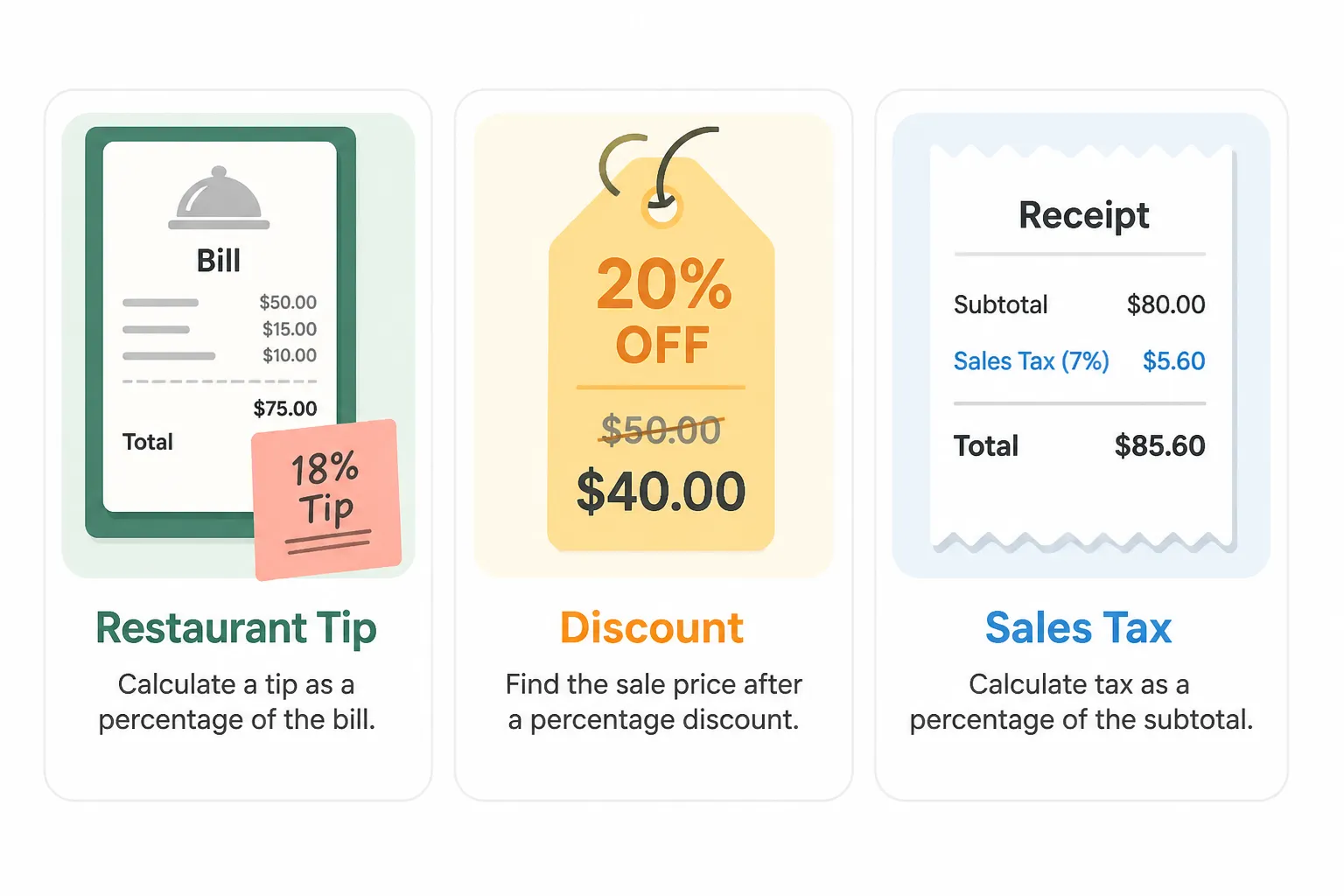
Percentages appear in daily calculations that all use the percentage-of-a-number formula:
- Tips: a 20% tip on a 45-dollar bill is 0.20 × 45 = 9 dollars.
- Discounts: 30% off a 60-dollar item is 0.30 × 60 = 18 dollars off, for a 42-dollar price.
- Sales tax: 8% tax on a 25-dollar purchase is 0.08 × 25 = 2 dollars.
Each case multiplies a whole by a decimal rate. A discount then subtracts the part from the whole, and tax adds it, so the percent off calculator applies the discount and the final price in one step.
Frequently Asked Questions
How do you calculate a percentage of a number?
Convert the percentage to a decimal by dividing by 100, then multiply that decimal by the number. For 20% of 80, divide 20 by 100 to get 0.20, then multiply 0.20 by 80 to get 16. The formula is Part equals Whole times Percent divided by 100.
How do you find 15% of a number?
Multiply the number by 0.15. For 15% of 200, multiply 200 by 0.15 to get 30. You can also find 10% by moving the decimal one place left, halve it for 5%, and add the two, which gives 20 plus 10 equals 30 for 15% of 200.
How do you calculate what percentage one number is of another?
Divide the part by the whole, then multiply by 100. For what percentage 16 is of 80, divide 16 by 80 to get 0.20, then multiply by 100 to get 20 percent. This reverses the standard percentage-of-a-number calculation.
How do you calculate a percentage increase or decrease?
Find the difference between the new and original values, divide by the original value, then multiply by 100. A rise from 80 to 100 is a difference of 20, divided by 80 is 0.25, which is a 25 percent increase. A fall uses the same steps and gives a decrease.
How do you calculate a percentage without a calculator?
Break the percentage into easy parts. Find 10% by moving the decimal one place left, find 1% by moving it two places, then combine. For 35% of 60, 10% is 6 so 30% is 18, and 5% is 3, giving 18 plus 3 equals 21.
Ready to run the numbers? Use the Percentage Calculator.