401(k) vs Roth IRA: How to Pick the Right Retirement Account
401(k) vs Roth IRA: How to Pick the Right Retirement Account
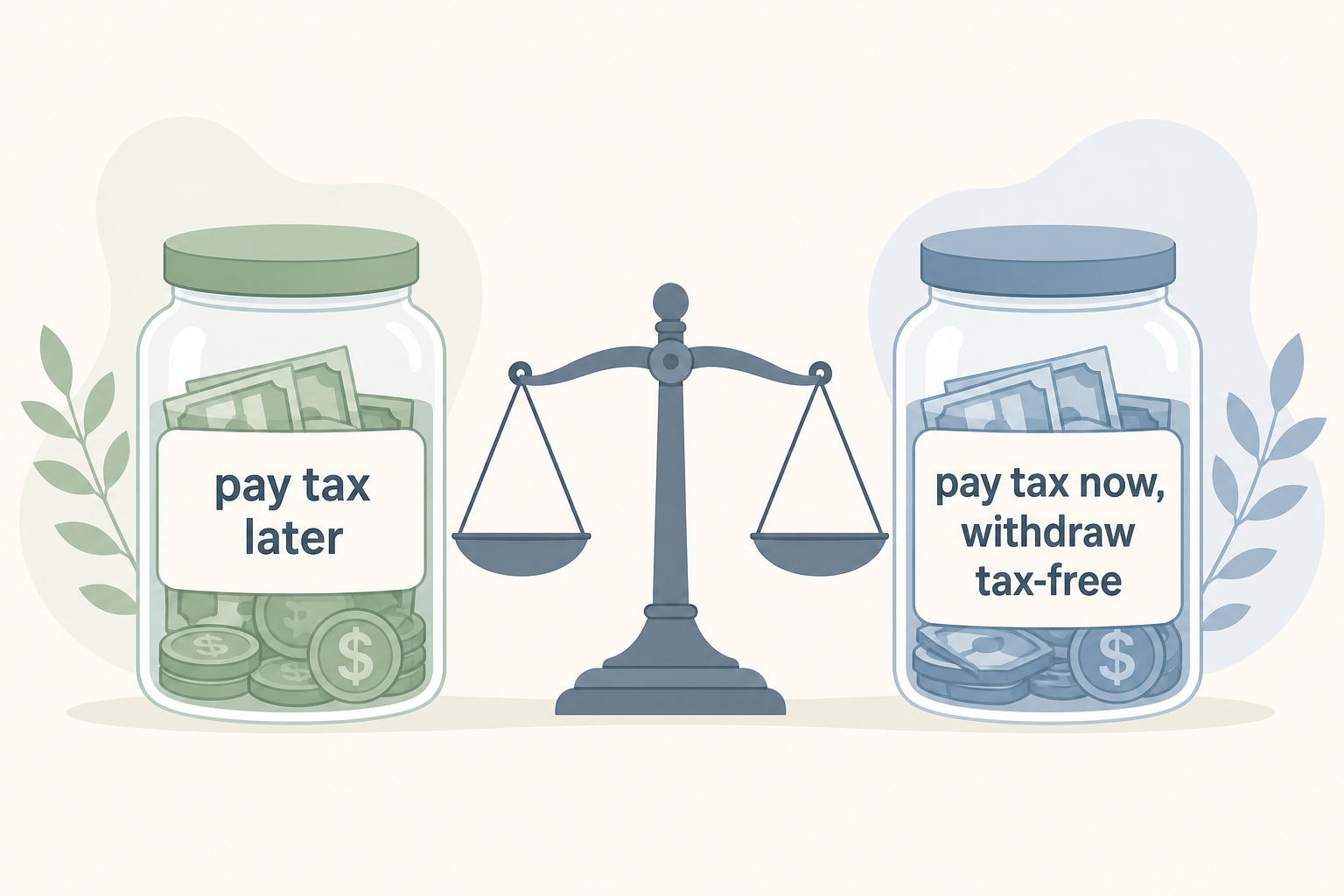
The choice between a 401(k) and a Roth IRA comes down to when you pay tax. A traditional 401(k) takes pre-tax contributions that lower your taxable income now and are taxed when you withdraw them in retirement. A Roth IRA takes after-tax contributions with no deduction now, and qualified withdrawals in retirement are tax-free. Most people benefit from holding both and funding them in a set order, starting with the employer match.
Which account you prioritize while you work affects your tax bill later. The sections below compare tax treatment, 2026 contribution limits, income rules, withdrawal rules, and a funding order you can follow. Run your figures through the 401(k) Calculator on Quick Calculators, or use the Roth IRA Calculator when you want a Roth-focused projection.
401(k) vs Roth IRA: Tax Treatment and Withdrawal Rules
The core difference is the order in which the tax is applied. One account defers the tax to retirement, and the other pays it now for tax-free income later.
Traditional 401(k): Pay Tax Later
A traditional 401(k) takes contributions from your paycheck before federal income tax, which lowers your taxable income for the year. The money grows tax-deferred, and every dollar withdrawn in retirement is taxed as ordinary income at the rate that applies then. This structure favors a saver who expects a lower tax rate in retirement than they pay today.
Roth IRA and Roth 401(k): Pay Tax Now, Withdraw Tax-Free
A Roth account reverses the sequence. You contribute after-tax dollars, so there is no deduction now and your taxable income does not fall this year. In return, qualified withdrawals in retirement, including all the growth, are tax-free. The Roth IRA and the Roth 401(k) share this tax treatment, but they differ on income limits, contribution limits, and required distributions, covered below.
Why Your Tax Bracket Is the Deciding Factor
Your current tax bracket, compared with your expected bracket in retirement, decides which account wins. A saver in a lower bracket now than they expect later pays less total tax by using a Roth account and paying now. A saver in a peak-earning year, whose pre-tax 401(k) deduction drops them into a lower bracket, captures real value from the deduction. Neither account is always better; the answer depends on where your income sits today against where it lands in retirement.
2026 Contribution Limits and the Employer Match
The two accounts have separate contribution limits, so you can fund both in the same year. The table below lists the 2026 limits set by the IRS.
| Account / saver (2026) | Base limit | With catch-up |
|---|---|---|
| 401(k) or Roth 401(k), combined | $24,500 | n/a |
| Age 50+ catch-up (401k) | +$8,000 | $32,500 total |
| Ages 60-63 catch-up (401k) | +$11,250 | $35,750 total |
| Roth IRA | $7,500 | n/a |
| Age 50+ catch-up (Roth IRA) | +$1,100 | $8,600 total |
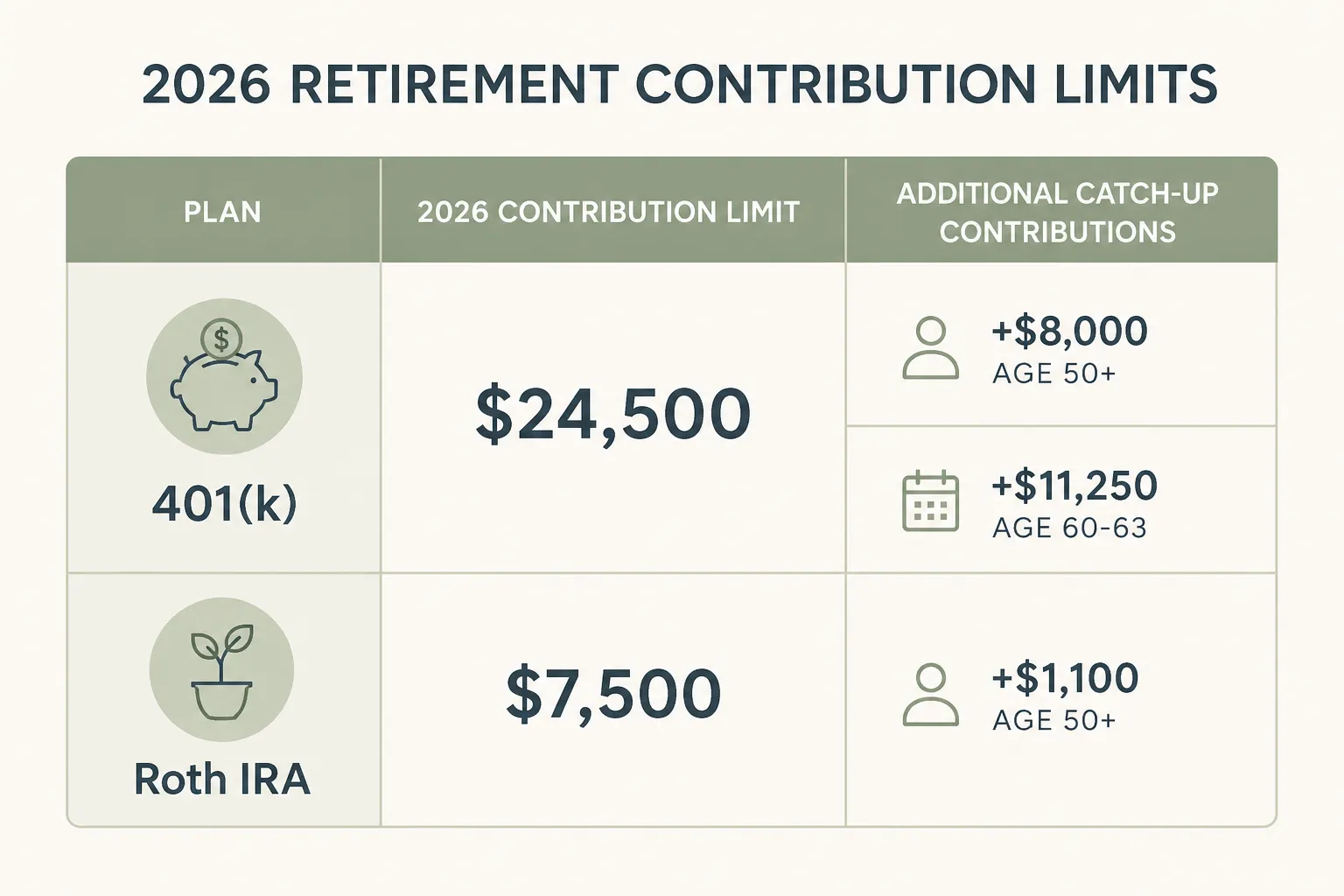
The 401(k) and Roth 401(k) share a single combined cap, so you do not get a separate $24,500 for each. The Roth IRA is a separate limit you can fund alongside the employer plan if your income qualifies. One 2026 change affects high earners: a worker whose prior-year wages with the employer exceeded $150,000 must make any age-based catch-up on a Roth basis.
Why the Employer Match Comes First
An employer match is an immediate, guaranteed return that no other account replicates, so capturing the full match comes before any other contribution. A common formula of 50 percent on the first 6 percent of salary returns 50 cents for every dollar contributed, before any market growth. An unclaimed match leaves guaranteed money behind.
The match has a tax detail worth knowing. Even when you contribute to a Roth 401(k), the employer match typically lands in a pre-tax account by default, so it is taxed as ordinary income when withdrawn. Some employers now offer a designated Roth match under SECURE 2.0, but that option is not yet standard across most plans.
Roth IRA Income Limits and the Backdoor Roth
The Roth IRA restricts direct contributions by Modified Adjusted Gross Income (MAGI), which is your adjusted gross income with certain deductions added back. For 2026, a single or head-of-household filer can make a full Roth IRA contribution below $153,000 MAGI, a partial contribution up to $168,000, and none above $168,000. Married filing jointly filers phase out between $242,000 and $252,000. The Roth 401(k) has no income limit, which makes it useful for high earners who cannot contribute to a Roth IRA directly. Model eligible contributions with the Roth IRA Calculator.
The Backdoor Roth for High Earners
A saver above the Roth IRA income limit can use a backdoor Roth IRA, the standard workaround. The process makes a nondeductible contribution to a traditional IRA, then converts that amount to a Roth IRA, and the conversion is generally tax-free because the dollars were already taxed. This route has no income limit.
Existing pre-tax IRA balances complicate the move. Under the IRS pro-rata rule, all traditional IRA assets count as one pool, which makes part of the conversion taxable. A transfer of pre-tax IRA balances into a current employer’s 401(k), when the plan accepts rollovers, removes those funds from the pro-rata calculation and clears the way for a clean conversion.
401(k) vs Roth IRA: Which Account to Prioritize
Beyond tax treatment, the accounts differ on access to your money and on forced withdrawals. These rules often decide the priority between them.
Roth IRA Flexibility and No Lifetime RMDs
A Roth IRA has two structural advantages beyond tax-free growth. First, you can withdraw your contributions, though not the earnings, at any time with no tax or penalty, because those dollars were already taxed. Second, a Roth IRA has no required minimum distributions during the owner’s lifetime, so you are never forced to withdraw, which helps both retirement-income and estate planning. Earnings become tax-free and penalty-free after age 59½, once the 5-year holding period is met.
Traditional 401(k) Withdrawal Rules and RMDs
A traditional 401(k) withdrawal before age 59½ triggers a 10 percent early-withdrawal penalty on top of ordinary income tax, with limited exceptions. In retirement, required minimum distributions begin at age 73 under current rules, so the IRS forces withdrawals whether you need the money or not. Those distributions can push income into a higher bracket. Higher reported income also raises Medicare premiums through IRMAA surcharges and can increase the tax on Social Security benefits. The RMD Calculator estimates the required amount by age.
Where the Roth 401(k) Sits
The Roth 401(k) blends features of both. Under SECURE 2.0, Roth 401(k) accounts no longer have required minimum distributions during the owner’s lifetime as of 2024, which aligns them with Roth IRAs. Qualified withdrawals stay tax-free. A rollover of a Roth 401(k) into a Roth IRA when you leave an employer still helps. It simplifies account management and adds the Roth IRA’s contribution flexibility and wider investment choice.
A Funding Order to Follow
A clear sequence turns the comparison into action:
- Contribute to the 401(k) up to the full employer match, whether traditional or Roth, for the guaranteed return.
- Fund a Roth IRA next if your income qualifies, for its tax-free growth and no-RMD flexibility.
- Return to the 401(k) and fill the remaining room up to the $24,500 limit.
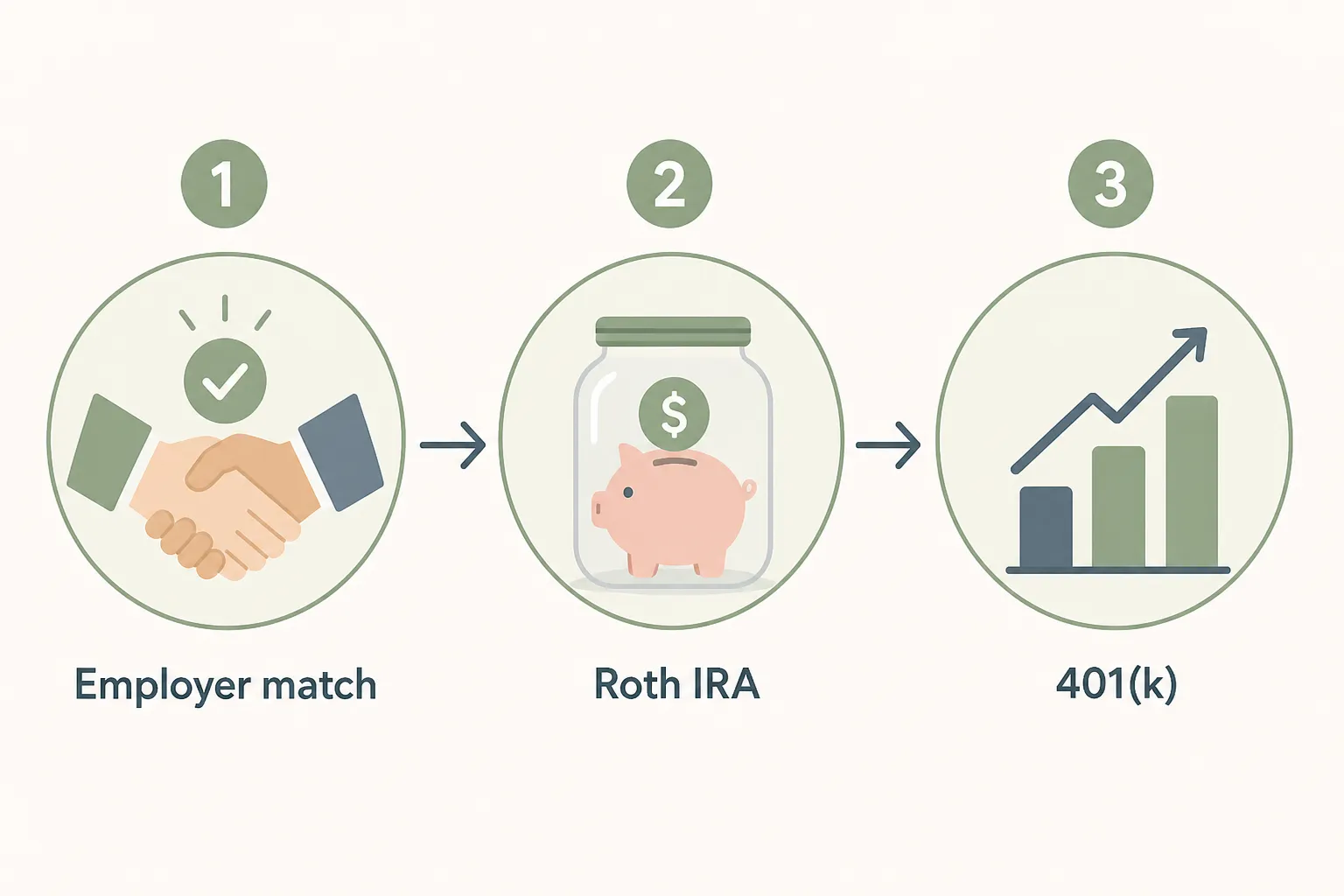
A high earner above the Roth IRA income limit swaps step two for a Roth 401(k), which has no income restriction. They can add a backdoor Roth IRA for coverage outside the employer plan. The sequence stays the same; only the specific accounts change with income. Run your income, bracket, and timeline through the 401(k) Calculator or the Retirement Calculator to see what each path is projected to be worth after decades of compounding.
When a Roth Conversion Is Worth Considering
A Roth conversion moves pre-tax 401(k) or traditional IRA money into a Roth account, and the converted amount is taxed as ordinary income in the year of the conversion. The best window is usually a low-income year, such as the gap between leaving work and starting Social Security, or before RMDs raise income. A conversion in that window pays tax at a lower marginal rate than once every income source is running.
A conversion of a large balance in a single year can push you into a higher bracket and raises IRMAA surcharges two years later. A partial conversion each year, filling only the current bracket, spreads the tax across several years and builds a larger tax-free pool without one heavy tax year. Conversions made in 2018 or later cannot be reversed under the Tax Cuts and Jobs Act, so the decision needs the full-year income picture in view.
Frequently Asked Questions
What is the difference between a 401(k) and a Roth IRA?
The main difference is when you pay tax. A traditional 401(k) uses pre-tax contributions that lower your taxable income now and are taxed when you withdraw them in retirement. A Roth IRA uses after-tax contributions with no deduction now, and qualified withdrawals in retirement are tax-free. A 401(k) is an employer plan with a high contribution limit; a Roth IRA is an individual account with income limits.
Should I contribute to a 401(k) or a Roth IRA first?
Contribute to your 401(k) up to the full employer match first, because the match is a guaranteed return no other account offers. After the match, fund a Roth IRA if your income qualifies, for its tax-free growth and withdrawal flexibility. Then return to the 401(k) and fill the remaining room up to the annual limit. The match comes first regardless of which account type you prefer.
Can I contribute to both a 401(k) and a Roth IRA in the same year?
Yes. A 401(k) and a Roth IRA have separate contribution limits, so you can fund both in the same year. For 2026 you can defer up to $24,500 in a 401(k) and up to $7,500 in a Roth IRA, provided your income is within the Roth IRA limit. Funding both is common and lets you balance pre-tax and tax-free savings.
What are the 2026 contribution limits for a 401(k) and a Roth IRA?
For 2026, the 401(k) elective deferral limit is $24,500, with an $8,000 catch-up at age 50 and older ($32,500 total) and an $11,250 catch-up at ages 60 to 63 ($35,750 total). The Roth IRA limit is $7,500, with a $1,100 catch-up at age 50 and older ($8,600 total). The 401(k) and Roth 401(k) share one combined limit.
What is a backdoor Roth IRA?
A backdoor Roth IRA is a legal workaround for people whose income is above the Roth IRA limit. You make a nondeductible contribution to a traditional IRA, then convert it to a Roth IRA. The conversion is generally tax-free because the money was already taxed. Existing pre-tax IRA balances can make part of the conversion taxable under the pro-rata rule.
Do Roth IRAs have required minimum distributions?
No. A Roth IRA has no required minimum distributions during the original owner’s lifetime, so you are never forced to withdraw the money. This is a key advantage over a traditional 401(k), which requires distributions starting at age 73. Under SECURE 2.0, Roth 401(k) accounts also no longer have lifetime required minimum distributions as of 2024.
Making the Decision
The choice between a traditional 401(k) and a Roth account is a bet on your future tax rate against today’s rate. A traditional account favors a saver in a high bracket now who expects a lower rate later, and a Roth account favors a saver who wants tax-free withdrawals, no forced distributions, and a tax rate they can lock in today. Most people benefit from holding both and funding them in order: the employer match first, a Roth IRA when eligible, then the remaining 401(k) room. Run your own income and timeline through the 401(k) Calculator before you change a contribution election.
This article is educational and does not replace personalized financial or tax advice. Contribution limits, income thresholds, and tax rules change, so confirm the current figures with the IRS and consider speaking with a qualified financial or tax professional about your situation.
Sources
Internal Revenue Service. 401(k) limit increases to $24,500 for 2026, IRA limit increases to $7,500 (IR-2025-111, November 13, 2025), and Notice 2025-67 (2026 cost-of-living adjustments). Available at irs.gov.
Ready to run the numbers? Use the 401(k) Calculator.